
The construction firms that will get the most from AI over the next five years are not the ones that bought the best tools. They are the ones that built the best data. That distinction matters more than most project teams currently realise, and the gap between structured and unstructured firms is already starting to show.
The AI Readiness Gap in Construction Projects
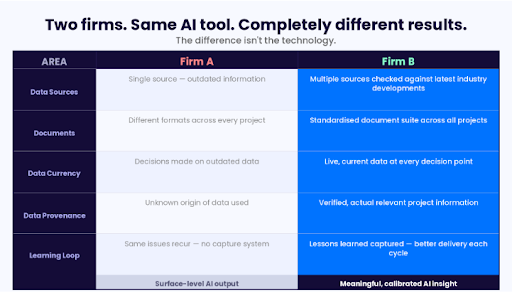
Two firms. Same AI tool. Same subscription cost. Completely different results.
This is already happening. One team extracts a first-pass programme risk analysis in minutes. The other generates something generic and essentially useless. The difference is not the technology – it is the quality of what they fed into it.
AI tools process what they are given. They compress patterns, surface anomalies, and generate outputs based on the information in front of them. When that information is clean, consistent, and well-structured, the results reflect it. When it is fragmented, inconsistently formatted, and built for human eyes rather than machine processing, the outputs reflect that too.
In construction, the latter is far more common than the former.
What Messy Construction Data Actually Looks Like
It is easy to assume data problems are obvious:
- Corrupted files
- Missing records
- Something visibly broken
In practice, construction data issues are far more subtle – and far more widespread.
A cost report might use “M&E” in one column and “Mechanical and Electrical” in another. A programme might list the same subcontractor under three slightly different names across separate packages. A risk register from project handover might reference a cost code that changed mid-project and was never consistently updated.
None of this is unusual. It is the natural result of multiple teams contributing under time pressure, across different systems, with no single standard for how information is recorded.
The problem is that AI does not interpret or reconcile these inconsistencies. It processes them exactly as they appear. So when the input is fragmented, the output is too.
And unless someone actively understands these gaps, AI-generated analysis can be acted on with a level of confidence that the underlying data does not deserve.
Construction’s Data Inheritance Problem
This is not a new problem – it is an inherited one. Construction project management has generated enormous volumes of data over decades: contracts, programmes, cost reports, RFIs, early warning notices, site instructions, inspection records. Almost none of it was structured with future analysis in mind.
- Individual projects developed their own document conventions.
- Firms acquired other firms and inherited their formats.
- Software platforms changed, and data migrated imperfectly.
- Lessons learned stayed in people’s heads rather than structured records.
The result is that most construction organisations are sitting on rich project history that is, for practical purposes, almost entirely inaccessible to AI tools. The asset exists. The ability to use it does not.
This is construction’s data inheritance problem – and it is unique in scale and complexity compared to most other industries. Other sectors have had years of cloud-based, standardised data infrastructure to draw on. Construction, largely, has not.
The Compounding Advantage
Here is what makes this urgent. Clean data does not just improve AI output today, it compounds over time. A firm that standardises its cost coding structures, programme formats, and risk registers from this point forward will, within two or three project cycles, have a dataset that AI tools can interrogate meaningfully:
- They will be able to identify which risk categories their projects consistently underestimate
- They will see where programme delay patterns repeat
- They will get early warning analysis calibrated to their actual project history, not generic industry benchmarks
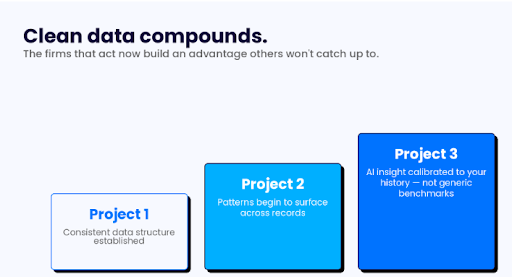
A firm that does not take this step will continue to get surface-level outputs regardless of which AI tool they buy.
McKinsey’s research on data-driven enterprises has consistently found that organisations investing in data architecture before AI deployment capture significantly more value than those that add AI to existing, unstructured data environments. Construction has no structural reason to be different, but it does have a longer history of underinvesting in data infrastructure than most sectors.
How to Improve Construction Data for AI
The good news is that the shift does not require a large technology investment. It requires three disciplines, applied consistently from the start of each project.
1 . Standardise Construction Data at Source
Agree naming conventions, cost code structures, and programme format standards before work begins. Not complex standards – simple, consistent ones that every contributor to the project follows. A shared template is worth more than the most sophisticated AI tool applied to inconsistent data.
2. Treat Programme Data as a Live Document
AI schedule tools need current, accurate programme data to be useful. A programme baselined at week one and never updated is not a programme, it is a record of original intentions. Keeping it current is basic project management discipline; it is also the foundation for any AI scheduling analysis worth running.
3. Capture Decisions, Not Just Documents
AI is increasingly able to surface patterns across project documentation, but only if that documentation records what actually happened and why, not just what was planned. A contract variation that is not logged, a scope change captured in an email but not in the risk register: these are the gaps where AI analysis breaks down.
None of this is technically complex. All of it requires deliberate habit change – and a shared understanding, across the project team, of why it matters.
The Window of Opportunity for Construction AI is Now
The firms competing most effectively with AI in 2026 have not necessarily deployed the most sophisticated tools. Many of them simply took the time to get their data in order first.
That is still an option for most construction organisations. It will not be indefinitely. The firms that act now – establishing data standards at project initiation, maintaining programme integrity, and building structured records rather than reactive documentation – will find AI tools for construction management considerably more powerful and considerably more useful than those who do not.
Source: McKinsey Global Institute (2023). ‘The Data-Driven Enterprise of 2025.’ McKinsey.com. / Kahua (2026). ‘Ready or Not: 7 Ways to Format Construction Project Management Data for AI.’ resources.kahua.com